Quentin Skinner’s book is a powerful reminder of the old adage that “no cause is ever lost because no cause is ever really won."
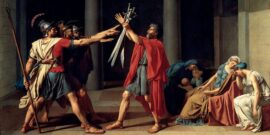
Quentin Skinner’s book is a powerful reminder of the old adage that “no cause is ever lost because no cause is ever really won."

The intellectual context of Lexington and Concord can help us understand why the minutemen fought.
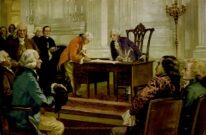
Gienapp’s new book is a serious historical attack on originalism, but it falls short of vanquishing it entirely.

Alison LaCroix’s new book reveals the vibrant debates over federalism and the Constitution in the years before the Civil War.

Public meaning originalists, living originalists, and living constitutionalists all tend to share an unequivocal acceptance of judicial supremacy.
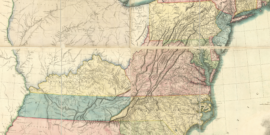
Interposition is a woefully neglected constitutional tool of the early republic.
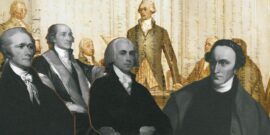
Reading Publius in his proper historical context allows us to understand both his strengths and his limitations.
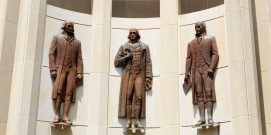
For twenty-four years, Jefferson, Madison, and Monroe strove to hold their party together and keep it true to its principles.
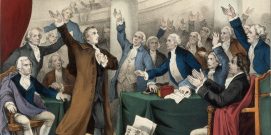
John Phillip Reid, who passed away in April, recovered the constitutional questions at the heart of the American Revolution.

Americans often adopted certain ideas only as a consequence of actions and debate: preconceived ideas did not drive or shape the founding.

Spencer Roane’s ardent defense of state sovereignty and Jeffersonian republicanism rub against the traditional story of early nineteenth-century America.

Daniel Webster and the Unfinished Constitution rehabilitates Daniel Webster as a constitutional and political thinker of the first order.
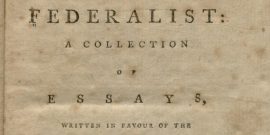
The Federalist remains a fruitful object of study with the potential to enlighten our understanding of its time and our own.

Taylor believed the rhetoric of economic and national greatness—"borrowed from the fallacious European theories" of empire—was deadly to a republic.

Conservatives should recognize that our embrace of the very constitutional vices the Anti-Federalists warned about has made our Republic one in name only.
Michael Faber provides a convincing account that Anti-Federalists supported a bill of rights, but only after their failure to stop the Constitution.
The debate reveals two incompatible visions of American constitutionalism and ordered liberty that are vital to understand today.